Why your journaling format actually matters
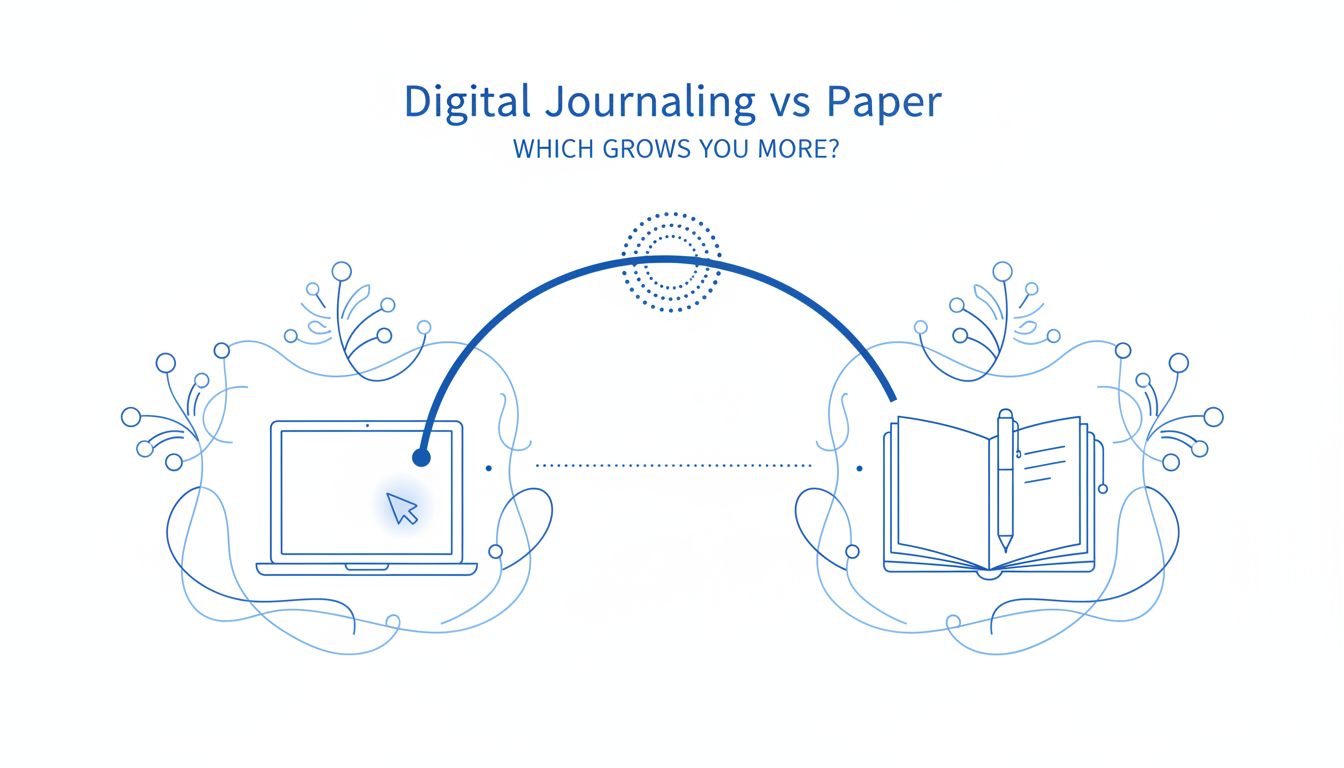
If you think digital journaling vs paper journal is just about "which is more aesthetic," you are quietly underestimating how much your tools train your brain.
Your journal is not neutral. It shapes what you notice, what you remember, and how honest you are with yourself.
Type something and your brain goes into speed and efficiency mode. Write something by hand and your brain often goes into meaning and memory mode.
Neither is automatically better. They just grow you in different ways.
FuturePost exists because letters to your future self can change the way you think today. The format you pick for those letters affects whether they become a cute idea you forget or a real habit that shifts your life.
Let’s unpack how.
How tools quietly shape your thoughts and habits
Your brain adapts to the tools you use most.
Spend all day in apps, and your mind starts to expect:
- Short bursts of attention
- Quick scroll, quick reward
- Edit, delete, polish, present
Sit with a notebook, and your mind gets trained for:
- Slower thinking
- Fewer distractions
- Imperfect first drafts
Imagine two people journaling about a breakup.
Person A types in a notes app. They pour out thoughts fast. They edit sentences, delete harsh lines, scroll back, reframe. It feels productive, almost like writing a statement.
Person B writes in a notebook. It takes longer. Their hand cramps. They cross out words, but the crossed-out words are still visible. It feels messy and raw.
Same topic. Different tools. Different emotional outcomes.
One might walk away with a cleaned-up narrative. The other might walk away with a more honest one.
[!NOTE] Your tool is not just where your thoughts land. It quietly trains you in how you think.
The mindset difference between screen and page
Screens come with a "get things done" mindset.
You associate laptops and phones with:
- Tasks
- Messages
- Performance
So when you open a journaling app, part of your brain is already in productivity mode. That can be great for reflection that needs structure, like reviewing your week or tracking habits. It can also make you feel like you need to write something "useful" or polished.
Pages come with a "no one is watching" mindset.
A paper journal does not ping you. It does not judge your grammar. It does not suggest a better sentence.
So your brain gets a bit more freedom to ramble and reveal. That is gold for self awareness.
Neither mindset is perfect. Screen can push you to be more consistent. Page can push you to be more honest.
The trick is to know which mindset you need for the growth you want right now.
What changes when you journal digitally
Digital journaling is more than "same thing, but on a screen." The environment changes the experience.
Think of it like working out at home vs at a gym. You are still doing pushups, but the context changes how you show up.
The real perks: searchability, privacy, and portability
Three digital advantages are hard to ignore.
1. Searchability
When your journal lives in an app, you can search it like a personal Google.
- Curious how often you write "anxious" or "burnout"? Search it.
- Want to see every time you mentioned a certain person? Search their name.
- Trying to track how your confidence changed this year? Search key phrases.
This is huge for pattern spotting. Most people never see their own patterns, they just feel stuck on repeat.
A quick example.
You search your digital journal for "tired" and realize you write it almost every Sunday night. Suddenly it is not just "I am exhausted." It is "I have a Sunday problem." That is actionable.
2. Privacy
Unless you live alone, a paper journal can feel risky. Someone could flip it open by accident or on purpose.
With digital notes, you can:
- Lock apps with a password or Face ID
- Hide journals behind boring app names
- Sync across devices without leaving books lying around
This matters if you want to write what you actually think, not what looks safe on your desk.
3. Portability
Your phone is probably with you almost all the time. Your hardcover journal is probably not.
Digital journaling shines when:
- You want to quickly capture a thought on the bus
- You wake up from a vivid dream and do not want to turn on the light
- You are traveling and do not want to pack extra weight
This is also where FuturePost is strong. Writing letters to your future self digitally means they can reach you wherever your future self is, not just where you left a notebook.
Here is a quick comparison.
| Benefit | Digital journaling | Paper journal |
|---|---|---|
| Search | Instant keyword search | Manual flipping |
| Privacy | App locks, passwords | Physical hiding only |
| Portability | Phone or laptop in pocket | Needs bag or desk |
| Backup | Cloud, multiple copies | Easy to lose or damage |
Digital wins big on logistics. The question is, what does it cost you mentally?
Hidden traps: distraction, over-editing, and app dependence
The perks are real. The traps are too.
1. Distraction by design
You open your journal app. You see a notification. Someone texted. Another app shows a red badge.
Two minutes later you are on Instagram "just for a sec." Ten minutes later, journaling is gone.
This is not a self control failure. It is environment design.
If your journaling lives in the same device that runs your entire social life, you are asking your brain to meditate in a nightclub.
You can still do it, but you need rules. Airplane mode. Focus mode. Or a dedicated journaling device, like an old tablet with nothing else on it.
2. Over-editing your emotions
Typing is fast. Deleting is seamless. So it is easy to turn your journal into a highlight reel.
You write, "I hate this class and I feel stupid." Then your inner editor kicks in. You soften it to, "I find this class challenging."
You are not lying, exactly. You are just cleaning up the mess before you even understand it.
Over time, your journal becomes more like a public statement than a private lab. You lose access to your real, unfiltered reactions, which are often where growth starts.
3. App dependence
If your entire reflection life lives in one platform, you are at the mercy of:
- Subscriptions
- Software updates
- Sync problems
- Companies shutting down
Most people do not export their entries regularly. If the app goes away, so does their history.
This app dependence can also sneak into your mindset. You start to believe you need the "perfect system" before you can reflect. Tags. Templates. Color coding. Features that feel like progress but delay actual writing.
[!TIP] When journaling digitally, think "good enough, often" instead of "perfect system, someday."
What paper journals still do better
Paper is not nostalgia. It is a different cognitive experience.
Your brain and body get involved in a way screens struggle to match.
Why writing by hand can deepen reflection
There is a reason many therapists still tell clients to "try writing it out by hand."
When you write manually:
- You slow down to the pace of your hand
- You have more time to notice what you are saying
- Your body is involved, not just your thumbs
Slowness is not a bug. It is the feature.
If your thoughts feel tangled and chaotic, speed can make them worse. Typing lets your brain sprint. Handwriting forces a walk.
Imagine you are spiraling about the future.
Typed version: you bang out three paragraphs in one minute. Your brain keeps up the same speed and anxiety.
Written version: by the time you finish the sentence "I am scared that I will never find work I love," you have already sat inside that fear for ten seconds. New thoughts start to show up, like "Actually, I have not really tried X yet." Insight sneaks in through the pauses.
There is also memory.
Handwriting usually creates stronger recall. That matters if you want to look back on your past self and understand how you got here.
When slow, imperfect pages beat polished digital notes
Paper wins where imperfection is the point.
A few examples.
- Processing big emotions
Grief, heartbreak, identity shifts, messy friendships. These are heavy. They deserve an environment that is not optimized for speed and shareability.
On paper, the crossed-out lines stay visible. The smudged ink and shaky handwriting tell a story your future self can feel, not just read.
- Creative thinking
Brainstorming life directions. Designing your next semester. Planning a big move. Paper lets you draw arrows, doodles, ugly mind maps.
It is hard to feel boxed in by structure when you can literally write diagonally across the page.
- Ritual and presence
Lighting a candle and opening a notebook puts you in a different mental space than tapping your phone in bed.
It signals, "This is my time. I am here with myself."
That kind of ritual is a growth accelerator because it makes you actually show up.
[!IMPORTANT] Your paper journal is allowed to be ugly. The more you let go of aesthetics, the more honest it usually becomes.
How to pick the right format for your season of life
There is no universal winner. There is only "what grows you most, right now, given your real life."
You can change your answer later. That is not failure. It is adaptation.
Questions to help you choose digital, paper, or both
Work through these questions honestly.
- Where do I currently spend most of my time?
If you are already on your laptop ten hours a day, maybe your journal should live off-screen as a break. Or, if your only reliable tool is your phone, digital might be the only realistic way to be consistent.
- What is my biggest journaling problem: starting or staying?
- If you struggle to even start, pick whichever feels easiest to open.
- If you start strong then disappear, pick whichever is easier to keep nearby.
- What am I journaling about right now?
Building habits, tracking goals, reviewing weeks Digital is strong here.
Exploring identity, processing emotions, surviving change Paper often does better here.
- How worried am I about privacy at home?
Constant fear of someone reading your notebook Digital with a lock could give you freedom.
Little siblings constantly on your phone Maybe a hidden paper notebook is safer.
- Do I want to analyze my past entries?
If you love the idea of searching old entries for patterns, digital is your playground. If you mostly want to feel and process, not analyze data, paper is enough.
You can also mix.
| Situation | Format that often shines |
|---|---|
| Daily quick reflection | Digital (notes app, FuturePost) |
| Deep emotional processing | Paper journal |
| Life planning and brainstorming | Paper, with diagrams and lists |
| Long term trend tracking and search | Digital |
| Travel reflection | Either, but digital is lighter |
Simple experiments to test what actually works for you
You do not have to guess. You can run mini experiments.
Experiment 1: One week split
- Week 1: Journal only digitally, once a day.
- Week 2: Journal only on paper, once a day.
At the end, ask:
- Which one did I actually do more often?
- In which format did I feel more honest?
- Where did I have more useful insights, not just words?
Experiment 2: Topic-based split
Pick two ongoing topics in your life.
Example:
- "Career / school direction" on paper.
- "Daily mood + habits" digitally.
Try this for fourteen days. See what each format naturally supports.
Experiment 3: Future self letters
Write two letters to your future self:
- One digitally, through a platform like FuturePost.
- One on paper, sealed in an envelope with a date on it.
Pay attention to:
- Which one felt easier to write.
- Which one you are more excited (or nervous) to open later.
Your body’s reaction here is data. Use it.
Bringing it together: build a journaling habit that lasts
The best format is the one you keep using when life gets chaotic.
A flawless system that collapses during midterms or busy season is not better than a scrappy system that survives.
Tiny routines that make reflection part of everyday life
Think small. Then smaller.
You do not need a 30 minute nightly reflection ritual. You need micro habits that you will actually do.
Some examples.
The 3 line rule Every night, write three lines. Digital or paper. No more required. If you want to write more, great. If not, you still win.
Anchor to something you already do Right after brushing teeth. Right after sitting on the bus. Right after you open your laptop for the day. Make journaling the "thing that always comes after X."
Location equals format Decide that your desk is for digital journaling and your bed is for paper, or the opposite. That way, you remove the decision fatigue of "how should I do this today."
Weekly future check-in Once a week, write a short note to your future self. Summarize: What did I learn about myself this week? Send it digitally with a tool like FuturePost so it comes back to you later as a built-in reflection moment.
[!TIP] Consistency is less about willpower and more about removing tiny decisions. Decide in advance where, when, and how you will journal.
Prompts to try tonight, whether you open an app or a notebook
Pick the format that feels easiest to start with tonight. Do not overthink it. Then try one or two of these.
- The pattern spotter
"What is one problem or feeling that has shown up more than once this month? What might it be trying to tell me?"
- The future letter
"Dear future me, here is one thing I am afraid to admit out loud right now, and what I hope you will have figured out by the time you read this."
- The energy audit
"When did I feel most alive in the last seven days? When did I feel most drained? What do those two moments have in common?"
- The kindness check
"If my best friend had the exact same day I had today, what would I say to them tonight?"
- The tiny experiment
"What is one tiny experiment I can run this week, to make my days 5 percent better, not perfect?"
Write messy. Write fast or slow. Digital or paper.
You are not trying to win journaling. You are trying to build a relationship with your own mind.
If you want an easy starting point, you could send a short FuturePost to yourself one month from now, summarizing who you are today and what you are wrestling with. Then, keep a paper or digital log of the small steps you take until that letter arrives.
When it lands, you will not just see words. You will see evidence of growth, and you will know which format helped you get there.