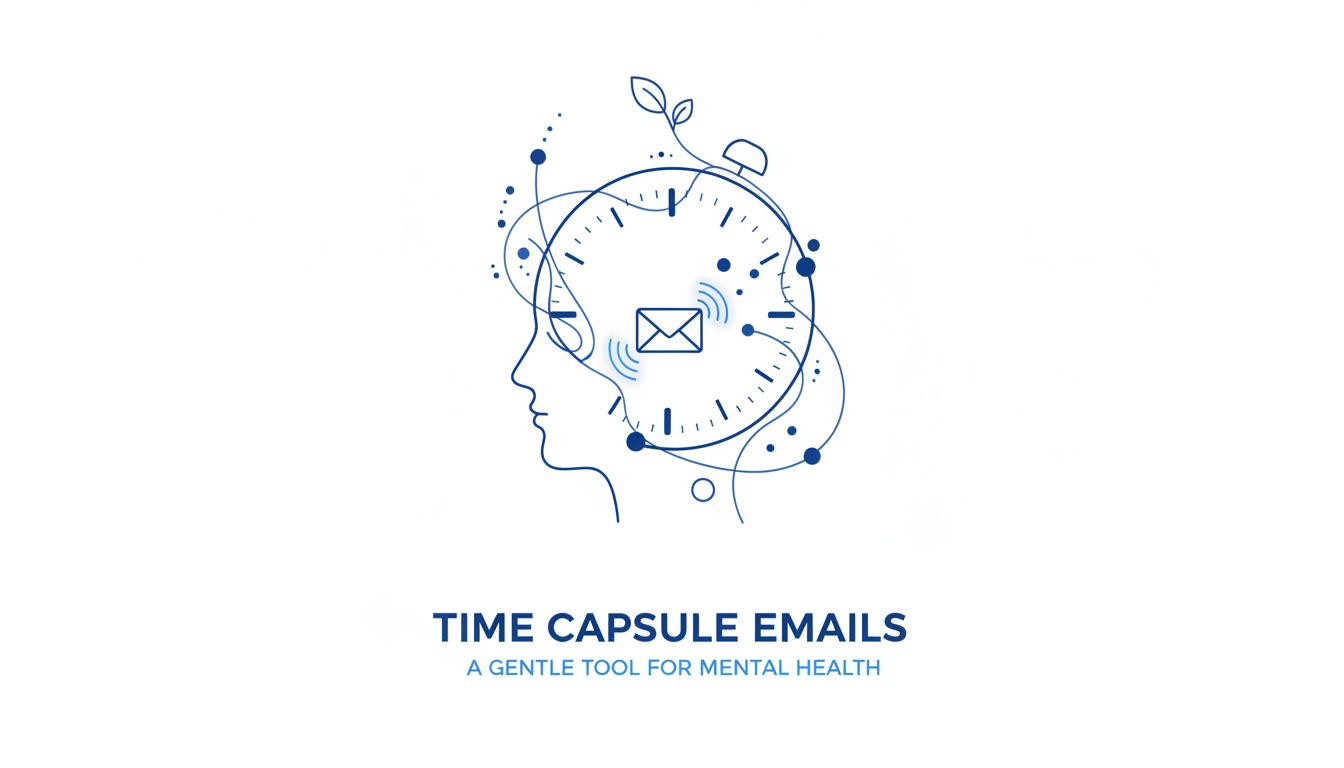
Time Capsule Emails: A Gentle Tool for Mental Health
Imagine opening your inbox a year from now and finding an email from you.
Not a cringe memory or a task reminder. A steady voice saying, "Here is what you survived. Here is what you learned. Here is what you wanted me to remember when things got hard."
That is the heart of time capsule emails for mental health. They are not productivity hacks. They are small acts of care that your present self sends to your future self.
Used with intention, they can quietly support therapy, coaching, and your own ongoing healing.
Let’s walk through how.
Why time capsule emails can matter more than you think
The quiet power of speaking to your future self
Most people underestimate how different their future self will feel.
In a crisis, it feels like the current version of you is the only version that exists. Future you feels distant or theoretical. Time capsule emails pull that future self into the room.
You are not just journaling. You are addressing someone specific. "Hey, three-months-from-now me. Here is what is happening. Here is what I hope for you."
That shift matters.
It reminds your brain you are part of a longer story, not just a bad chapter. It gives shape to hope without forcing toxic positivity.
There is also something disarming about knowing your future self will be the reader. You do not have to perform. You do not have to impress. You already know the audience very well.
Many people find they can be more honest in a future email than in a notebook they might re-read immediately. There is some built-in emotional distance.
[!NOTE] Speaking to your future self is a form of self-attachment. You practice staying in relationship with yourself over time, instead of abandoning past versions of you once they feel "cringey" or "weak."
How this practice supports emotional regulation and hope
Time capsule emails are not a replacement for professional support. They are more like scaffolding between sessions.
Here is what they can gently support:
Emotional regulation. When you write an email for a future moment, you step slightly outside your current emotion. That tiny bit of perspective can soften intensity. You notice, "I am overwhelmed, but I am also someone who can describe being overwhelmed." That is regulation.
Hope that has weight. Generic hope sounds like, "It will all work out." Time capsule hope sounds like, "I know you are still worried about money. When I wrote this, we had just made a realistic plan with our coach. I hope you stuck with it for at least two weeks. If you did, that counts as success."
Tracking growth that your brain ignores. Brains are biased toward what is wrong. Future emails capture what is changing. When future you reads them, you get hard evidence that you do not stay stuck forever, even if it feels that way.
Over time, the pattern becomes clear. You suffer. You adapt. You learn. You forget that you adapted and learned. Your own time capsule emails hand that proof back to you when you need it.
What time capsule emails actually are (and how they differ from regular journaling)
At the simplest level, a time capsule email is just a message you write now and schedule to arrive later.
That is it. No magic.
What gives it power is what you choose to send into that gap between now and later.
Letters, reminders, or check ins: different formats that work
You do not need a single "right" format. In practice, time capsule emails usually fall into three loose styles:
| Format | What it feels like | When it helps most |
|---|---|---|
| Letter | Longer, reflective, like a thoughtful email | After big sessions, transitions, or breakthroughs |
| Reminder | Short, directive, like a sticky note | For habits, coping tools, or values you forget |
| Check in | A few questions for your future self to answer | For tracking patterns and emotional trends |
Example: Letter
"We just ended therapy and you are exhausted. Today you finally said out loud that you are lonely. I am proud of you for not decorating it or shrinking it. I hope future you has at least one person you feel safe texting when you are sad. If not, that is okay. You are still worthy of that kind of person."
Example: Reminder
"When you feel like everything is collapsing, try the 3 minute grounding we practiced. Feet on the floor. Name 5 things you see. Touch something cold. You do not have to fix your life in this moment. Just get through this hour."
Example: Check in
"When you read this, how are mornings feeling lately. Are you still waking up with dread. If yes, is there one tiny thing that makes them 5 percent easier, like music or opening the window."
Each format asks something different of your brain. Letters invite reflection. Reminders cut through noise. Check ins keep you in conversation with yourself.
Many people who use FuturePost mix formats depending on what life looks like that week. The tool is flexible enough to handle a long heartfelt letter or a two-line nudge.
Why sending it into the future changes how your brain engages
Regular journaling tends to be about now. Time capsule emails are about now in relation to later.
That small shift changes how your brain processes things.
A few things happen:
You naturally zoom out. When you imagine your future self reading, your perspective widens. You are still in your feelings, but you also notice context. "I am anxious today, but I am also two days before a big presentation." That combo is more workable than pure "I am just broken."
You write more for clarity and less for venting. Venting has its place. But if you know your future self will read this on a Tuesday afternoon in 6 months, you are more likely to include what you want them to do with it. "If you are still feeling this way, please consider mentioning it in therapy again."
You create a built in pattern detector. One email is a snapshot. Ten emails over a year become a data set. You start seeing: "I always crash emotionally around the end of a big project." or "My loneliness spikes when I stop doing that Sunday walk."
Journaling can absolutely do all of this. The difference is that scheduling the messages forwards makes your brain treat them as signals for "future coping," not just "today's emotional dump."
[!TIP] If you already journal, experiment with writing one entry per week as a time capsule email instead. Same content, different destination. See if the tone or insight shifts.
How to use time capsule emails alongside therapy or coaching
Used with support, time capsule emails can act like tiny bridges between sessions.
The point is not to fix yourself by email. The point is to extend the work you are already doing with someone you trust.
Turning session insights into future support
Therapy and coaching sessions are dense. You walk out with insights, strategies, reframes. By Thursday, half of it can feel blurry.
Time capsule emails let you send forward the parts that matter most.
For example:
- Right after a session, write an email summarizing one or two key takeaways, in your own language, not therapist-speak.
- Add a few specific examples of when you might forget this insight.
- Schedule that email for a time that is historically hard for you. Sunday evening. The week before a family visit. The day of a recurring work review.
Concrete example:
"We realized that when I say 'I am lazy,' what I really mean is 'I am scared and overwhelmed.' Future me, if you are calling yourself lazy again, pause. Ask: what am I scared of right now. You are not lazy. You are overloaded."
Instead of your insights vanishing into the notes app graveyard, they show up in your inbox in the moment they are most needed.
Some people even create a recurring rhythm. After each session, one FuturePost email. Short, honest, targeted.
Safely revisiting difficult seasons without re-traumatizing yourself
There is a risk here. If you time capsule raw, traumatic content without support, opening that email can hit like a flashback.
You want gentle contact with past pain, not a surprise emotional ambush.
A few ways to keep this safer:
Write from your current groundedness, not from the center of the storm. If you are actively in crisis, it might not be the right time to time capsule at all. More on that later.
Include care instructions in the email. Literally tell your future self how to read it.
Example: "If reading this makes your chest feel tight, stop halfway. Put a hand on your heart or on something solid. Remind yourself: this is a past version of me. I survived this night."
Choose your timing intentionally. Do not schedule heavy emails for dates that are already loaded. Anniversaries of loss. Exams. Court dates. Choose relatively neutral days, ideally with support nearby.
Use your therapist or coach as a co-architect. You can say, "I want to send a time capsule email about this season. How can I frame it so future me is supported, not overwhelmed."
[!IMPORTANT] If you have a history of trauma, self harm, or intense flashbacks, talk with your therapist before sending time capsule emails about your heaviest experiences. Together you can decide what is safe, and what might be better held inside session work only.
Setting realistic expectations with your therapist or coach
Time capsule emails are a tool, not homework you must "succeed" at.
Before you integrate them into your work:
- Tell your therapist or coach you are using something like FuturePost.
- Clarify what feels helpful. Is it post session summaries. Gentle reminders of coping tools. Notes about patterns.
- Decide how, if at all, you will bring these emails into your sessions. You might forward one occasionally, or just jot down themes that keep reappearing.
It is fine to experiment and then drop it for a while.
You are not failing the tool. You are just discovering what your nervous system has capacity for.
What to write about when you do not know where to start
Staring at a blank "To: Future Me" line can feel oddly intimidating.
You are not alone in that.
Instead of forcing a perfect letter, treat your first few emails like experiments. You are learning your own future voice.
Prompts for anxious, overwhelmed, or stuck versions of you
Aim your email at one specific future state. "Overwhelmed me." "Frozen me." "Spiraling me."
Here are some simple starting lines you can adapt:
- "If you are reading this and your brain is racing, try this first..."
- "Here is what I know is true about us, even when you cannot feel it..."
- "Here is one thing you do not have to decide today..."
- "If everything feels pointless right now, remember this story..."
Example for anxious you:
"If you are reading this at 2 a.m. scrolling your phone, hi. You are rehearsing every possible disaster. I get it. Earlier today we practiced naming 'what is in my control' and 'what is not.' Grab a scrap of paper. Split the page in two. Put at least one thing in each column. You do not have to stop worrying. Just give the worry something to sit on."
Example for stuck you:
"If you still feel paralyzed about starting that project, lower the bar. Your only task today is to open the document. That is it. If you do more, great. If you do not, you still wins. Yes, 'wins.' Plural. Because getting unstuck is a series of tiny wins, not one big heroic push."
Capturing wins, skills, and truths you do not want to forget
Your brain is shockingly bad at remembering your own growth.
Use time capsule emails as a running archive of things you would normally minimize.
- The day you actually set a boundary.
- The first time you texted a friend instead of isolating.
- A moment where you felt genuinely proud, not just "fine."
Email idea:
Subject: "Proof you are changing, from past you"
"Today we told our boss we needed more time, and nobody exploded. You were sweating. Your voice shook, but you did it. I know future you will try to claim you never stand up for yourself. Here is written evidence that you do."
You can also catalog your skills and tools, so future you has a menu to choose from.
For example:
"Here are 5 things that sometimes help us when the fog rolls in:
- Texting [friend] just 'Can you send a meme.'
- Leaving the house for 5 minutes, even just to the mailbox.
- Putting on a familiar show as background noise.
- Drinking a full glass of water.
- Writing a ridiculously honest, unsent letter in your notes app."
This is not about creating the perfect coping list. It is about reminding future you that you are not starting from zero.
Balancing honesty with kindness toward your future self
You do not owe your future self a polished version of you. You do owe them respect.
A few guiding questions as you write:
- "If someone I cared about opened this while they were struggling, how would it land."
- "Is this email punishing future me, or supporting them."
- "Am I speaking to myself the way I wish others had spoken to me."
There is room for anger, grief, and frustration. Just notice if your words tip into cruelty.
"Get it together by now" is not motivation. It is shame.
Try these shifts:
From "Why are you still like this." To "If you are still like this, that is okay. Here is one small thing we can try next."
From "Do not mess this up again." To "This matters to us. I know you will do your best with the resources you have that day."
Kindness does not mean fake positivity. It means telling the truth without turning on yourself.
Staying gentle: boundaries, timing, and next steps
Like any mental health tool, time capsule emails work best when you set clear edges around them.
You are allowed to say, "Not right now."
When to pause or avoid time capsule emails
It might be better to pause this practice if:
- You are in acute crisis or actively suicidal.
- You find that opening past emails consistently spikes your distress.
- You feel pressured to write "perfect" messages and end up more anxious.
- Your therapist or coach has concerns about how you are using them.
In those seasons, real time support matters more than typed future support.
You can always come back to time capsule messages later, or use them only for lighter content, like tracking goals or small joys.
[!NOTE] A simple rule of thumb: if writing or reading these emails leaves you feeling more resourced, you are likely in the right zone. If it leaves you flooded, numb, or ashamed, it is time to adjust or pause.
How often to send them and for how far into the future
There is no perfect schedule. There is only what you can sustain without resenting it.
A few common rhythms people land on:
Weekly for a few months. Great for focused work, like a specific therapy block, a grief season, or a coaching container.
After big emotional events only. You write when something genuinely shifts, not on a calendar.
Monthly "state of the self" emails. A simple snapshot of how you are doing, what you are learning, and what you want future you to remember.
As for timing, a rough guide:
- 1 to 4 weeks: good for reinforcing new habits or fresh insights.
- 3 to 6 months: good for perspective and seeing real change.
- 1 year or more: good for life chapters. Graduations. Moves. Major losses. New roles.
You can mix them. A short reminder in 1 week. A longer reflection in 6 months.
FuturePost makes it easy to schedule multiple emails at once, then forget about them until they arrive. That "forgotten" period is actually helpful. It reduces the urge to over curate.
Other future self practices to explore if this resonates
If the idea of writing to your future self feels grounding, there are adjacent practices you might explore, either alone or with support:
Audio messages to future you. Record a voice note and schedule a reminder to listen later. The tone of your own voice can be surprisingly moving.
Future letters on paper. Write a physical letter and seal it with a date. Old school, but very tangible.
Future-self visualization. Common in coaching and some therapy modalities. You imagine meeting a future version of you and asking what they know that you do not yet. You can later translate that into a time capsule email.
Value check ins. Once a quarter, write an email answering, "What matters to me right now." Schedule it for a year from now. Notice what shifts and what stays solid.
The format is less important than the relationship you are building with yourself across time.
You do not have to turn time capsule emails into a grand project.
You can start with one small note. To next week. To next month. To the version of you who might forget what you learned today.
If you want a simple way to experiment, try this:
Open FuturePost or any time capsule email tool. Write three sentences to the you who will be alive 30 days from now.
Tell them what you are carrying. Tell them one thing you hope they remember. Schedule it, then go live your life.
Consider everything after that a conversation you are slowly learning to have. With yourself. For yourself. Over time.